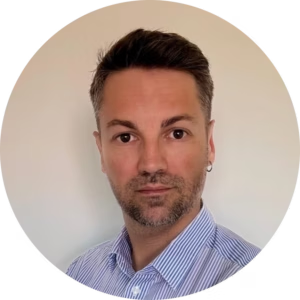
Thomas Jezequel (Advanced Practice Nurse, Nantes University Hospital, France) has dedicated more than 13 years to caring for children and families through complex treatment pathways. With expertise in transplantation and cellular therapies, he reflects on the evolving role of nurses in the era of CAR-T cell therapy, the importance of research and the promise of artificial intelligence in future care. As local organizer of the 17th EBMT Nurses Group Educational Meeting, he highlights the value of international collaboration, knowledge exchange and preparing the next generation of nurses for a rapidly changing field.
Q1. Could you tell me a little about your career journey, and what drew you to oncology nursing?
I have been working at Nantes University Hospital for 13 years; first as a nurse and, for the past 5 years, as an Advanced Practice Nurse. I quickly developed a strong interest in this field, both because of the high level of technical skills required and the clinical reasoning that constantly stimulates and enriches nursing practice. Finally, the relationship between the triad of caregiver–child–parents/family is particularly rewarding on a daily basis and has further strengthened my passion for this specialty.
Q2. What advice would you give to younger nurses or students wishing to pursue a path in oncology and haematology nursing?
Embracing this specialty as a nurse is extremely rewarding, both professionally and personally. It offers a high level of technical expertise, which is often sought after at the beginning of a career. It also allows nurses to consolidate many of the skills acquired during training, which are useful in other areas of practice as well. Although this specialty can be challenging, perseverance usually pays off. Finally, it is a field rich in therapeutic innovation, which regularly brings new learning opportunities and continuously stimulates professional growth.
Q3. Treatment advances such as the growing use of CAR T-cell therapy and personalized treatment approaches have evolved significantly in recent years. How has this impacted the role of nurses?
These new treatments provide patients and families with new curative perspectives. Our role is to guide them through care pathways that are often complex. We also have an essential mission of making highly technical medical information accessible. For treatments such as CAR-T, it is crucial to support patients in understanding the information they receive in order to strengthen their self-care skills, which are a key factor in the success of these procedures. This requires great adaptability from nurses; in learning and implementing these treatments, as well as in daily bedside monitoring. It is essential to train quickly and effectively, and then to share this knowledge with peers. Moreover, close collaboration between the medical team and the nursing team is fundamental to ensuring the quality and safety of care. All of this has been brought to the forefront by the arrival of these treatments, which have reshaped and redefined our daily practice.
Q4. In your view, what are the key priorities for the future of oncology and haematology nursing care?
From my perspective, nursing research will be a key area to continue investing in. Our more experienced colleagues have already produced a solid body of evidence in this field. The arrival of new therapies, along with evolving nursing roles, open up many new avenues for research that need to be explored. In addition, in a constantly changing world, it will be vital to prepare our care teams to face these new challenges, in order to ensure high-quality care for patients. The COVID-19 pandemic is a strong example of the adaptability that nurses – and healthcare providers more broadly – had to demonstrate. This experience has already taught us valuable lessons that will help us prepare for the future. In the face of these challenges, future generations of nurses will also have new tools at their disposal. Artificial intelligence (AI) will undoubtedly play an increasing role in nursing care in haematology and transplantation. We will thus have the opportunity to experience a new revolution – one that, I hope, will bring even greater success in our procedures and improved outcomes for our patients.
Q5. You are the local organizer of the upcoming 17th Educational Meeting of the Nurses Group – what are you most excited about in this year’s programme?
Honestly, the whole programme excites me! We co-designed it with the members of the EBMT Nurses Group and the GFIC-GM (the French nurses’ group), and I really like the result. Personally, I am particularly eager to attend several sessions on acute leukaemia, infections and also the Research Committee workshop, which will feature some very promising presentations on the use of AI in research.
More broadly, I see this as a wonderful collaboration: it gives French nurses a unique opportunity to learn from expert colleagues from abroad, to build connections, to create a professional network… and perhaps even to open up new perspectives and foster collective reflection on our shared daily challenges.
About Thomas Jezequel
Thomas Jezequel (Nantes University Hospital, France) is an Advanced Practice Nurse (APN) in pediatric oncology and haematology. He has worked in this specialty for over 13 years, including 5 years as an APN. His daily practice combines high-level technical expertise, clinical reasoning and close collaboration with children and their families throughout the transplant journey. He is also actively involved in the EBMT Nurses Group and the French nursing group GFIC-GM, where he contributes to the promotion of advanced nursing practice, research and international collaboration in HSCT and cellular therapy.
The EBMT Nurses Group brings together nurses and allied health professionals working in the field of haematology and HCT. The mission of the Nurses Group is to improve the care of our patients through evidence-based practice and to enhance and value the nursing role worldwide by supporting and sharing knowledge through communication, advocacy, research, training and education.
Disclosure: This short article was prepared by touchHAEMATOLOGY in collaboration with the Multinational Association of Supportive Care in Oncology (MASCC). No fees or funding were associated with its publication. Thomas Jezequel has no financial or non-financial conflicts of interest to declare in relation to this article.
 Related content
- Dr Esra Gülderen on learning, leadership and lifelong growth: touchHAEMATOLOGY Future Leader 2025
- Chia Jie Tan: Working together to advance cancer research
- Empowering young haematologists: Insights from the EBMT Trainee Committee co-chairs
Cite: Nursing in the era of CAR T and AI: A conversation with Thomas Jezequel. touchHAEMATOLOGY. October 10th, 2025
SIGN UP to touchHAEMATOLOGY!
Join our global community today for access to thousands of peer-reviewed articles, expert insights, and learn-on-the-go education across 150+ specialties, plus concise email updates and newsletters so you never miss out.