EBMT

With the recent FDA approval of narsoplimab for transplant-associated thrombotic microangiopathy, the field is moving from recognition to intervention. Dr Eleni Gavriilaki discusses the evolving role of complement inhibition, endothelial-directed strategies, and why earlier-career researchers will be central to advancing ...

In proud collaboration with EBMT, we have captured the highlights from the recent 52nd Annual Meeting, EBMT 2026. Below, hear from Dr Anna Sureda, President of EBMT, Dr Rafael Duarte, Congress President, and other world-leading experts sharing some of the most ...

At EBMT26, Prof Claire Booth presented a plenary session on gene therapy in primary immunodeficiencies. In this interview, she reflects on the field’s most important milestones, how gene therapy compares with allogeneic transplantation, and the critical challenge of ensuring patients can actually access these transformative treatments.

HSV infection remains a persistent and often debilitating complication in immunocompromised patients, particularly following transplantation. At EBMT26, Dr Genovefa Papanicolaou presented results from the phase III PRIOH-1 trial, highlighting the efficacy and safety of pritelivir – an oral antiviral with the potential to reshape management of acyclovir-resistant HSV.

At EBMT26, Prof Meral Beksac discusses data from the phase III PERSEUS trial, where adding daratumumab to standard VRd induction and consolidation – followed by daratumumab–lenalidomide maintenance – has delivered striking gains in sustained MRD negativity and progression-free survival. The findings reinforce a shift toward quadruplet therapy as the new standard of care in TE NDMM.

At EBMT26, Dr Roni Shouval presented his plenary abstract: a novel approach to one of the field’s persistent challenges: scalable, real-time immune monitoring following CAR-T therapy. In this interview, Dr Shouval discusses the clinical rationale, technological framework, and future implications of this emerging methodology.

At EBMT26, Prof Florent Malard presented the final results of the phase III ARES trial evaluating fecal microbiota transfer MAAT013 in a challenging clinical setting: ruxolitinib-refractory acute graft-versus-host disease (GvHD) with gastrointestinal involvement. With few effective options and poor outcomes in this setting, the study highlights how this novel microbiome-based, immunomodulatory approach by restoring gut microbiome diversity to modulate the immune system could redefine third-line treatment.

As 2025 draws to a close, we’re celebrating another remarkable year of growth, collaboration and innovation at touchHAEMATOLOGY. From thought-provoking expert interviews and peer-reviewed research to dynamic conference coverage and an expanding portfolio of medical education, this year has been defined by meaningful conversations and impactful learning. We’ve had the privilege of engaging with leading clinicians, researchers and partner societies across the globe - bringing together diverse voices to support the haematology community with timely, accessible and authoritative content. As we reflect on the past 12 months, we’re proud to highlight the moments, milestones and stories that shaped our year.
2025 has brought exciting developments in haematology, with groundbreaking research and real-world progress showcased at EHA, ASH, EBMT and many more leading conferences around the world. We asked our key faculty to share what they believe has been most impactful so far this year – here’s what they told us.

ASH25 delivered some of the most transformative data to date in cellular therapy and transplantation — from engineered Treg grafts and optimized conditioning to CRISPR-driven CAR-T enhancements and universal base-edited cells achieving deep, durable remissions. These data signal a new era where transplantation and cell therapy merge into a precision-curative platform. In this piece, Dr Esra Gülderen breaks down seven major abstracts from ASH25, highlighting their take-aways and considering their potential relevance for clinical practice.
Discover the latest breakthroughs in hematological malignancies from ESMO 2025, including bispecific CAR‑T, MRD‑guided therapy, and novel immunomodulatory combinations. From cutting-edge risk stratification in DLBCL to macrophage-targeted strategies in MDS, these insights are shaping the future of treatment.

Dr Thomas Jezequel, Advanced Practice Nurse at Nantes University Hospital, shares his journey in pediatric oncology and haematology, his advice for new nurses, and his vision for the future. From CAR T-cell therapy to AI, he highlights the evolving role of nurses and the importance of collaboration and research.
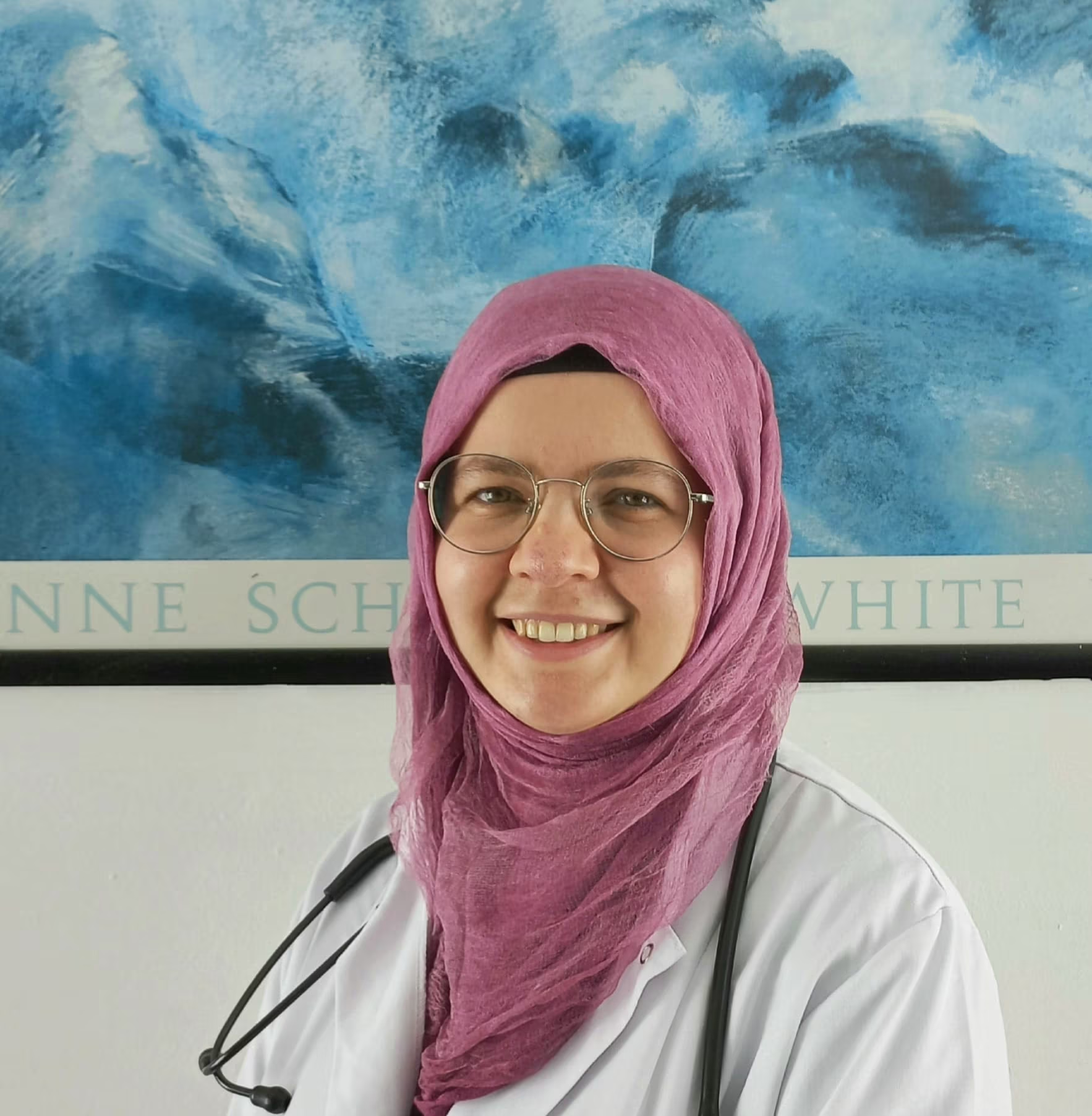
Dr. Esra Gülderen discusses her path into hematology, the critical role of mentorship, and how early research experiences shaped her confidence. Now a Co-chair of the EBMT Trainee Committee, she shares what motivates her and why clear communication, curiosity, and resilience are essential traits for aspiring haematologists.
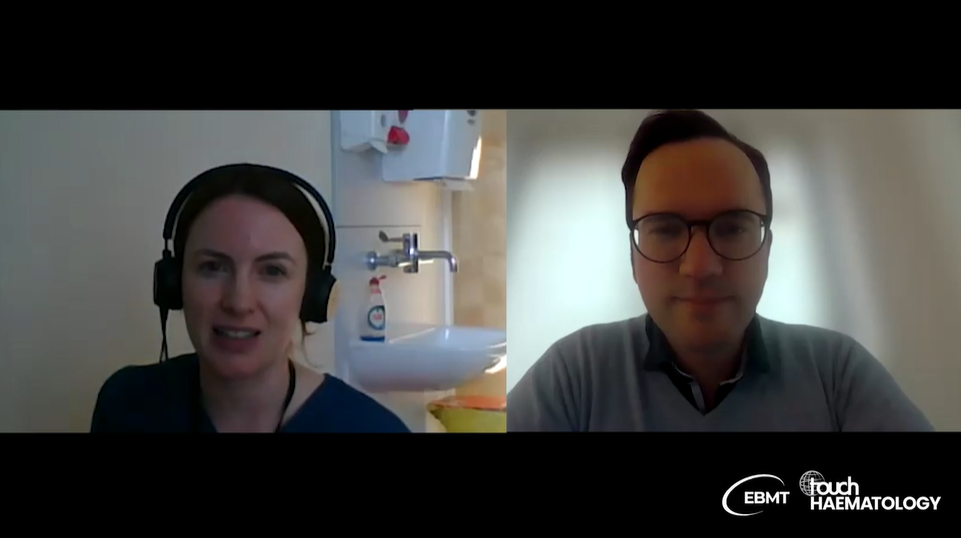
This interview features Dr Nico Gagelmann (University Medical Center Hamburg-Eppendorf, Hamburg, Germany) and Dr Claire Horgan (Royal Manchester Children's Hospital, Manchester, UK) co-chairs of the European Society for Blood and Marrow Transplantation (EBMT) Trainee Committee. Together, they discuss their motivations ...
[touchplayvideo video_id="dcp3wd8s3c"] This interview features Dr Nico Gagelmann (University Medical Center Hamburg-Eppendorf, Hamburg, Germany) and Dr Claire Horgan (Royal Manchester Children's Hospital, Manchester, UK) co-chairs of the European Society for Blood and Marrow Transplantation (EBMT) ...
We delve into the exploratory analysis of the DETERMINATION study data, which suggests a potential meaningful progression-free survival (PFS) benefit for African American (AA) patients receiving RVd-alone treatment. We also examine safety findings, noting a similar safety profile between AA and White patients, despite the high prevalence of Duffy-null alleles in AA patients. However, we observe that neuropathic toxicity may be higher in AA patients. Finally, we discuss how these clinical insights could influence treatment decisions for newly diagnosed multiple myeloma patients
Chimeric antigen receptor (CAR) T-cell therapy has emerged as a groundbreaking approach in the treatment of relapsed or refractory haematological cancers, fundamentally altering the landscape of cancer care. By harnessing the body’s immune system, this therapy effectively targets and destroys cancer cells, demonstrating remarkable efficacy particularly in acute lymphoblastic leukaemia (ALL) and diffuse large B-cell lymphoma. At the forefront of advancements discussed during EBMT 2024, Dr. Sridhar Chaganti highlighted pioneering strategies, including the development of allogeneic CAR T-cell therapies. These therapies not only exhibit potential in reducing Graft-versus-Host disease but also show promise in improving cell expansion, marking significant progress in overcoming treatment limitations. Moreover, innovative approaches aim to address associated side effects such as cytokine release syndrome (CRS) and immune effector cell-associated neurotoxicity syndrome (ICANS). Among these, the introduction of the JAK1 inhibitor, itacitinib, stands out as a promising avenue for mitigating adverse reactions and enhancing patient outcomes in the realm of CAR T-cell therapy
Recent studies have highlighted the promising effects of belumosudil, axatilimab and faecal microbiota transplants in treating Graft-versus-Host Disease (GVHD). These significant advancements were underscored at the EBMT 50th Annual Meeting

 touchHEMATOLOGY
Register Now!
Explore the latest in medical education and stay current in your field. Create a free account to track your learning.
- Save your progress for video
- Keep track of your CME credits
- Add personalised learning notes
- Receive updates from course leaders and faculty
- Be the first to hear about new and exciting interactive learning opportunities
Log into your Touch Account
Keep track of your clinical interests and newsletter subscriptions.
Sign up with an Email
Or use a .
Register now for FREE access
Already registered? Login below.