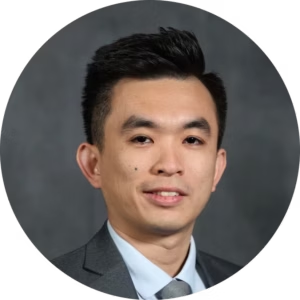
Chia Jie Tan (Research Assistant Professor, University of Utah College of Pharmacy, Salt Lake City, UT, USA) has a background in clinical haematology pharmacy in Malaysia and board certification in oncology pharmacy. He now focuses on advancing supportive care as cancer treatments grow more complex. Recently named the MASCC 2025 President Training Fellowship recipient, in this interview, he reflects on the importance of collaboration, mentorship and the evolving role of pharmacists in oncology research and practice. Tan emphasizes the need for proactive supportive care strategies to address the unique toxicities and long-term effects of novel cancer therapeutics.
Q1. Many congratulations on being named the MASCC 2025 President Training Fellowship recipient. What does receiving this award mean for you personally and professionally?
On a personal level, it represents an opportunity to learn from and be mentored by senior leaders within MASCC, whose expertise and experience I greatly respect. Their guidance will be invaluable as I continue to grow as an independent researcher. Professionally, the award provides a platform to engage directly with MASCC leadership in advancing the vision of Supportive Care 2030. Working alongside experienced researchers who have shaped the field will allow me to better understand how we can collectively move towards evidence-based, patient-centred supportive care worldwide. I see this as both a recognition of my current work and a unique chance to contribute meaningfully to the future direction of the field.
Q2. What is the most valuable lesson a mentor has shared with you, and how has it influenced your work?
I learned from my PhD supervisor the importance of teamwork and collaboration. He dedicated considerable effort to building a team of researchers with complementary skills and engaging collaborators across disciplines, ensuring that research questions were addressed from multiple perspectives. This lesson proved invaluable as I transitioned into my current role as an independent researcher. When developing new research questions and projects, I actively seek input from peers and mentors, particularly those with expertise different from my own. Their perspectives help me identify potential blind spots and often generate new angles not previously thought of. More importantly as a junior researcher, I often receive innovative ideas that enable me to make the most of limited resources and achieve meaningful impact.
Q3. How do you see supportive care evolving as cancer therapies become more targeted and complex?
In the past two decades, drug development has accelerated dramatically, introducing new treatment modalities and drug classes with novel mechanisms of action and distinct toxicity profiles. Immunotherapy, for instance, has transformed the treatment of many tumour types, yet optimal strategies for managing its immune-related adverse events are still being defined. The challenge is further compounded by toxicities that are rare but severe, often emerging only during postmarketing surveillance in a larger patient population, as well as late or long-term effects that are observed after extended follow-up. This highlights the need for supportive care to evolve in parallel, not only to develop strategies that address the side effects of novel therapeutics, but also to incorporate proactive monitoring into survivorship care. As the therapeutic landscape continues to expand, supportive care must anticipate and manage both immediate and delayed effects to ensure that patients fully benefit from novel cancer therapeutics while maintaining quality of life.
About Chia Jie Tan
Chia Jie Tan (Research Assistant Professor, Department of Pharmacotherapy, College of Pharmacy, University of Utah, Salt Lake City, UT, USA) has strong research interests in oncology outcomes research and cancer survivorship. He received his pharmacy education from the University of South Australia and subsequently practiced as a haematology pharmacist in Malaysia, receiving board certification in 2016. He currently dedicates most of his time to research but remains passionate in advocating for the role of pharmacists in the delivery of oncology care and oncology research. He is a member of the International Society of Oncology Pharmacy Practitioners (ISOPP), Multinational Association of Supportive Care in Cancer (MASCC) and the International Society of Pharmacoeconomic and Outcomes Research (ISPOR).
About the Multinational Association of Supportive Care in Oncology (MASCC)
The Multinational Association of Supportive Care in Cancer (MASCC) is an international, interdisciplinary organization dedicated to the practice, education and research of supportive care in cancer. Their mission is to continually improve the supportive care of people with cancer – from diagnosis through to survival or end-of-life care.
Disclosure: This short article was prepared by touchHAEMATOLOGY in collaboration with the Multinational Association of Supportive Care in Oncology (MASCC). No fees or funding were associated with its publication.
Related content
- The future of cancer survivorship care: 3 questions with Dr Darren Haywood
- Supportive oncology focus: Dr Díez de los Ríos de la Serna on integrating science and empathy
- Three questions with Abigail Ajanel Gomez: touchHAEMATOLOGY Future Leader 2025
Cite: Chia Jie Tan: Working together to advance oncology research. touchHAEMATOLOGY. September 17th, 2025
SIGN UP to touchHAEMATOLOGY!
Join our global community today for access to thousands of peer-reviewed articles, expert insights, and learn-on-the-go education across 150+ specialties, plus concise email updates and newsletters so you never miss out.