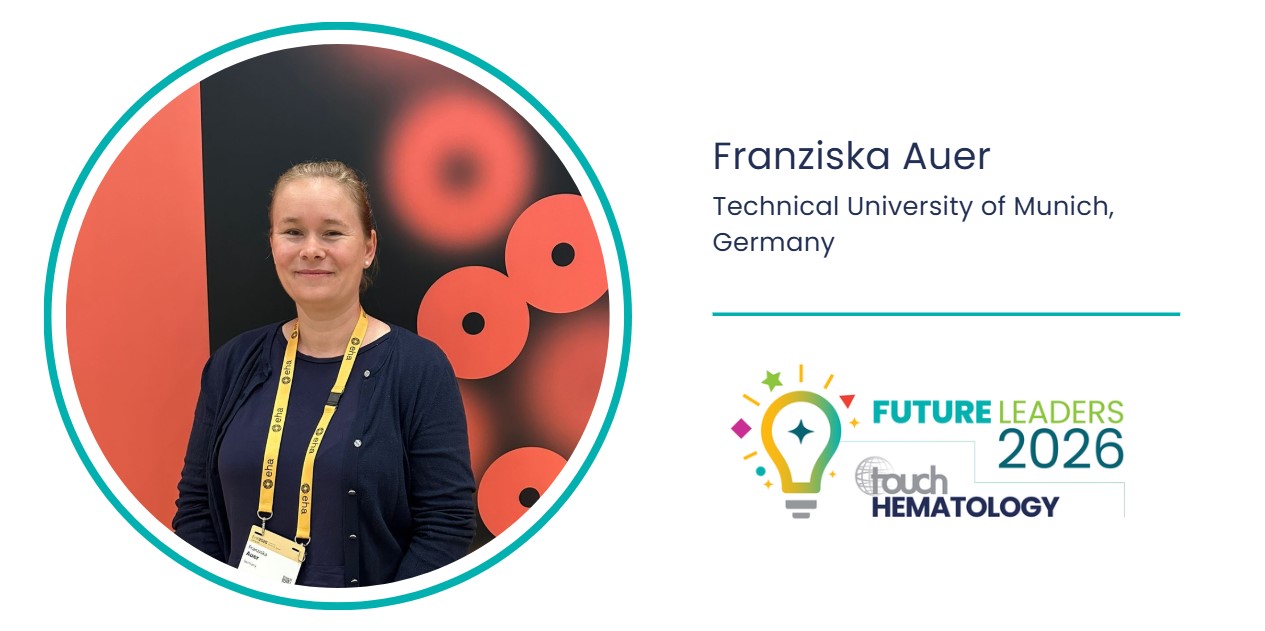
 We are delighted to announce Dr Franziska Auer as a touchHEMATOLOGY Future Leader 2026, selected by her peers as a rising star poised to shape the future of pediatric leukemia predisposition research.
As a biotechnologist turned pediatric hematology researcher, Dr Franziska Auer’s career is focused on understanding the genetic basis of childhood leukemia and translating these discoveries into improved patient care. Her work on inherited predisposition to B-cell acute lymphoblastic leukemia has established her as a rising leader in the field, while her active involvement with the European Hematology Association reflects her commitment to collaboration and supporting the next generation of researchers.
In this touchHEMATOLOGY Future Leaders interview, Dr Franziska Auer reflects on her journey into pediatric hematology research, the importance of mentorship and collaboration, and her mission to improve outcomes for children with inherited predisposition to leukemia.

“Young researchers have an important voice, and it’s essential that we create opportunities to showcase their work”
What inspired you to pursue a career in hematology?
I’m actually a biotechnologist by training rather than a physician, so my path into hematology was a little different. From an early stage, I knew I wanted to work in translational biomedical research, but it was during my PhD that I first became involved in hematology. I was working with a family in which their three children had all developed B-cell acute lymphoblastic leukemia. That experience sparked my interest in pediatric leukemia and genetic predisposition. When very young children develop leukemia, lifestyle-related risk factors are unlikely to explain the disease, so understanding the underlying genetics became a fascinating question.
Our research identified a germline mutation in the PAX5 gene that predisposed these children to developing leukemia, and that discovery has shaped my research ever since. Today, I work with international collaborators to identify similar families and improve surveillance and clinical recommendations for those at risk.
Along the way, I’ve also been fortunate to have excellent mentors, including Dr Arndt Borkhardt and Prof Julia Hauer, who have been incredibly supportive throughout my career.
What has been the most rewarding moment in your career so far?
There have been many rewarding moments. Every scientific discovery, publication or successful grant feels like another small contribution towards improving patient care.
One of the highlights has definitely been my involvement with the European Hematology Association (EHA). Being selected as a Translational Research Training in Hematology (TRTH) scholar introduced me to an amazing network of mentors and fellow researchers, many of whom have become close friends and collaborators.
More recently, serving on the Young EHA Committee has been particularly meaningful because it gives me the opportunity to give something back to the hematology community. One area I’m especially passionate about is supporting researchers with young families. As a parent of two young children myself, I understand the challenges of balancing family life with an academic career, and I want to help make that journey a little easier for others.
Receiving an EHA Advanced Research Grant at this year’s congress was also a very special moment. The grant will support my work exploring how PAX5 dysregulation influences responses to immunotherapies, building on our previous discoveries in genetic predisposition.
What advice would you give to students and early career professionals considering a career in hematology?
My advice is simple: definitely do it. But from the beginning, focus on building your network and finding the right mentor. A good mentor should introduce you to the community, support your development and, importantly, allow you to build your own scientific identity. That’s incredibly valuable because collaboration is central to modern research. Science has become increasingly collaborative, and working together is how we make the greatest advances.
I would also encourage young researchers to become involved with organizations such as the EHA as early as possible. Programmes like TRTH, the EHA Mentorship Programme and the Scientific Working Groups are fantastic opportunities to meet people, develop new skills and become part of the wider hematology community. Those connections can have a lasting impact on your career.
How important is it to spotlight and support early career professionals?
I think it is incredibly important. We often focus on established leaders in the field, but it’s equally valuable to highlight the work of early career researchers and clinicians. Seeing what others at a similar career stage are achieving can be inspiring and helps people understand how they can contribute to the field themselves. These initiatives give young professionals visibility, help them connect with the wider community and demonstrate that it’s possible to make a meaningful contribution from the very beginning of your career. I think that’s something worth celebrating.
Disclosures: This short article was prepared by touchHEMATOLOGY in collaboration with Dr Franziska Auer. No fees or funding were associated with its publication.
Citation: Dr Franziska Auer on inherited cancer risk in pediatric leukemia: touchHEMATOLOGY Future Leaders 2026. touchHEMATOLOGY. 22 July 2026.
Register now to receive the touchHEMATOLOGY newsletter!
Don’t miss out on hearing about our latest peer reviewed articles, expert opinions, conference news, podcasts and more.