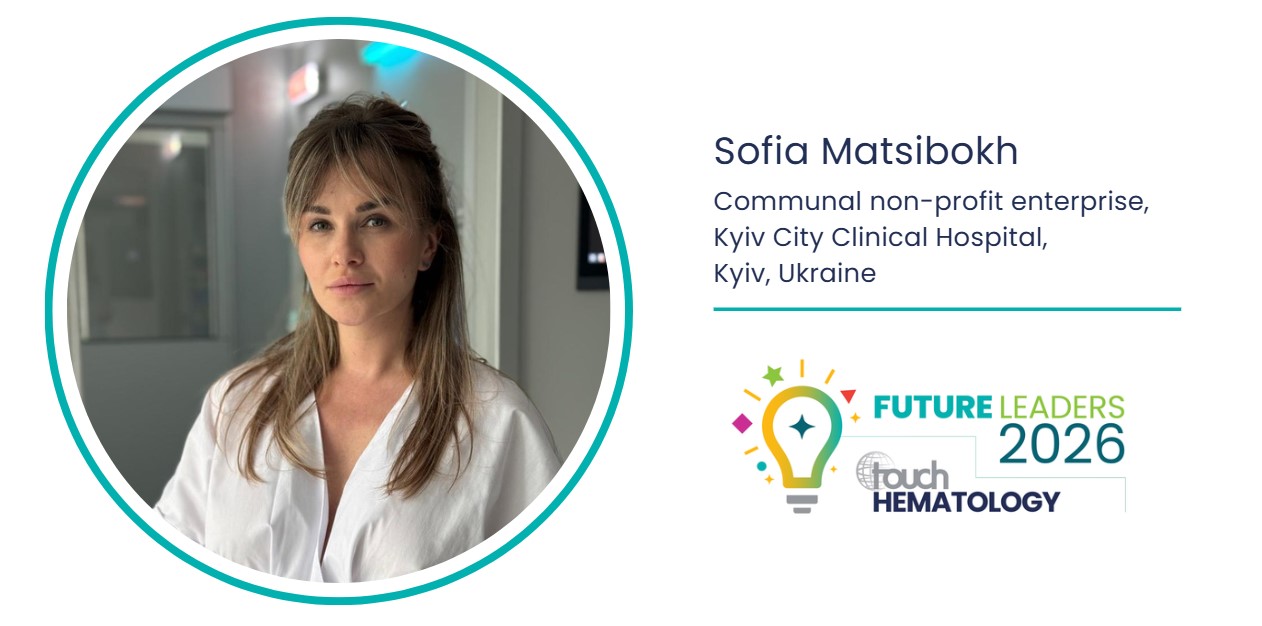
 We are delighted to announce Dr Sofia Matsibokh as a touchHEMATOLOGY Future Leader 2026, selected by her peers as a rising star poised to shape the future of bone marrow transplantation in children and adults.
Dr Sofia Matsibokh is a practicing hematologist at Kyiv City Clinical Hospital, Kyiv, Ukraine. She balances advancing her career during the ongoing conflict, a very high patient load and the shortage of physicians. Her professional path reflects a rare combination of scientific courage, clinical mastery, and human resilience. Her team performed the first haploidentical stem cell transplantation in her country and carried out the first transplantation for a patient on dialysis, opening therapeutic possibilities where none previously existed. She successfully applied an innovative immunotherapy approach in a pediatric case at a time when such strategies were not yet formalized for children, demonstrating her ability to make responsible, life‑saving decisions in conditions of uncertainty. Despite war, shelling, and constant danger, she continues to work, treat, and support her patients, remaining a model of professional and moral steadfastness. Her experience, courage, and ability to lead others make her truly worthy of this recognition.
In this touchHEMATOLOGY Future Leaders interview, she reflects on the experiences that have shaped her career, from the mentors who taught her the importance of responsibility and compassion to the patients who continue to inspire her every day. She discusses the challenges of making complex clinical decisions, the need to balance scientific precision with empathy and the importance of involving patients as partners in their care. Looking ahead, Dr Matsibokh also shares her optimism for the future of hematology, highlighting the potential of emerging technologies and the need to ensure innovation translates into meaningful improvements in patient care.

“Medicine is not simply about diseases – it is about people living with fear, hope, uncertainty and extraordinary resilience. The most rewarding moments are seeing a patient who was critically ill begin making plans for the future again.”
Can you tell us about a mentor who significantly impacted your career, and the most valuable lesson they shared with you?
My path in hematology began at Okhmatdyt, a place where medicine is neither polished nor filtered. It was there that I realized what protocols sometimes describe as ‘risk’ is, in real clinical practice, often the only chance a patient has.
My mentors: Drs Svitlana Donska, Oleh Ryzhak, Yuliia Bazaluk and Nataliia Kaverdakova, and the nursing team including Svitlana Romanchenko, Tania Vitkovska, Liuda Lushch and others shaped me not through lectures, but through their example. They taught me to work with precision, urgency and courage, while always remaining compassionate. Even today, I often ask myself, “What would they say?” It has become my internal compass.
They also taught me that medicine requires responsibility. Clinical reality does not always fit neatly within guidelines, and there are moments when doctors must carefully balance evidence, urgency and the individual needs of the patient. Those lessons continue to guide every decision I make.
What aspects of your work do you find most fulfilling?
The most rewarding moments are often the simplest. Seeing a patient who was critically ill just days earlier smile again, make plans, ask for coffee or say, “I want to go home,” reminds me why I chose this specialty.
Hematology does not allow superficiality. Every success is hard-earned, and every decision carries weight. There are cases that stay with you forever – complex transplants, patients with very limited options and children whose circumstances fall outside standard treatment pathways.
Sometimes, helping those patients means exploring approaches that are not yet widely established, coordinating urgently across multiple teams or finding treatments under challenging circumstances. These decisions require careful clinical judgement and a willingness to accept responsibility. When those patients leave the hospital alive and looking towards the future, you know that every difficult decision was worthwhile.
To me, this is what hematology is about: combining scientific evidence with thoughtful clinical judgement, always keeping the patient’s best interests at the centre of every decision.
What have your patients taught you throughout your career?
My patients have taught me what no textbook ever could. Medicine is not simply about diseases – it is about people living with fear, hope, uncertainty and extraordinary resilience. When you see a mother who has not slept for days, or a child asking for one more story before a procedure, you begin to understand that compassion is not separate from clinical practice – it is part of it.
They have taught me patience, humility and responsibility. Sometimes the bravest thing a doctor can do is simply remain present during uncertainty. Those experiences have shaped not only how I practise medicine, but also the kind of physician I strive to be.
How do you balance scientific precision with compassionate patient care?
Hematology demands mathematical precision, but no formula works without trust. I combine rigorous clinical reasoning with honest conversations, shared decision-making and helping patients feel that they still have a sense of control over their treatment. Precision may save the body, but empathy helps care for the whole person. For me, patients are partners in every decision. Their values, their tolerance for risk and their personal priorities matter just as much as laboratory results. When decisions are made together, they become not only clinically sound, but also ethically grounded.
Looking ahead, what do you anticipate will be the biggest advancements in hematology over the next decade?
The future of hematology is about much more than developing new therapies. Cellular therapies, genome editing, personalised medicine and AI-supported decision-making are already transforming the field.
The next major step will be ensuring these innovations become accessible in everyday clinical practice rather than remaining confined to conference presentations or specialist centers. The challenge will be closing the gap between scientific progress and its implementation, so that patients can benefit from advances as quickly and safely as possible.
I believe the next decade will belong to clinicians who can integrate innovation responsibly, combining new technologies with sound judgement, clinical experience and compassion.
What advice would you give to early-career hematologists?
Don’t learn medicine only from textbooks – learn it through responsibility.
Your most complex patients will teach you more than any lecture, and uncertainty will teach you humility. The moment you admit that you do not know something is often the moment real professional growth begins.
Above all, never lose your humanity. In hematology, compassion is not separate from good clinical practice – it is an essential part of it. Every patient deserves not only evidence-based treatment, but also honesty, empathy and the confidence that their doctor is fully committed to finding the best possible path forward.
Disclosures: This short article was prepared by touchHEMATOLOGY in collaboration with Dr Sofia Matsibokh. No fees or funding were associated with its publication.
Citation: Dr Sofia Matsibokh on courageous decision-making and compassion: touchHEMATOLOGY Future Leaders 2026. touchHEMATOLOGY. 22 July 2026.
Register now to receive the touchHEMATOLOGY newsletter!
Don’t miss out on hearing about our latest peer reviewed articles, expert opinions, conference news, podcasts and more.