“Even unexpected results can be the starting point for breakthrough discoveries”
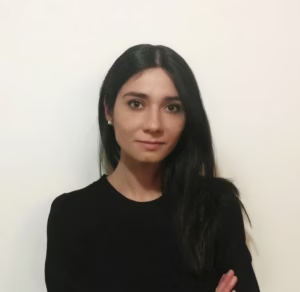
Dr Simona Maria Di Modica (IRCCS San Raffaele Scientific Institute, Milan, Italy) shares the inspirations, discoveries and future directions that shape her work in iron metabolism and erythropoiesis. Reflecting on the influence of her mentor, Dr Antonella Nai, she describes the importance of channeling energy with precision and remaining open to evolving goals. Dr Di Modica explains the intellectual satisfaction of seeing carefully planned experiments succeed – and the equal value in extracting meaning from unexpected results. She also discusses how metabolic aspects of red blood cell production are emerging as a fertile area for therapeutic innovation, particularly in anemia. Her advice for early-career scientists is clear: embrace opportunities, cultivate technical skills and approach research with curiosity, adaptability, and scientific rigor.
- Can you tell us about a mentor who has had a significant impact on your career, and the most valuable lesson they have shared with you?
I have the privilege of living and working in an era when outstanding scientists have shaped – and continue to shape – the history of haematology. Brilliant minds have uncovered the fundamental mechanisms of hematopoiesis and iron metabolism. Attending scientific congresses and having the opportunity to engage in discussions with such pioneers is an extraordinary moment of growth and a constant source of inspiration. It’s a time to be embraced with both curiosity and intelligence.
However, the person who has undoubtedly shaped my professional and scientific path is my mentor, Antonella Nai, Group Leader of Regulation of Iron Metabolism Unit, San Raffaele Scientific Institute. Thanks to her, I was able to give structure to the passion and intellectual rigor that have always defined me, transforming my natural inclinations into achievements in a fresh, thoughtful, and high quality way. One of the most intelligent lessons I learned from her is the importance of channeling energy with precision – directing enthusiasm, ideas and ambition into focused, meaningful work. This approach has helped me grow not only as a researcher but also as a thinker and person, and continues to guide me every day.
- What aspects of your work do you find the most fulfilling?
The most fulfilling aspect of my work is seeing an experiment I had carefully planned from the beginning yield the desired results. It’s a clear sign that there was solid reasoning and a deep understanding of the underlying mechanisms. But what fascinates me just as much is the ability to find meaning and solutions even in unexpected results. Being able to shift perspective based on experimental needs is, to me, one of the most intellectually stimulating parts of the job. Additionally, another fascinating aspect is the awareness of how even a single experiment can significantly impact our overall understanding of a biological process. This gives our daily work a strong sense of responsibility, reminding us that each step forward – no matter how small – can contribute meaningfully to scientific knowledge and, potentially, to future therapeutic strategies.
- Looking ahead, what do you anticipate will be the biggest advancements or changes in your field over the next decade?
One of the most innovative and promising directions in haematology research – something we have indeed already begun to observe in recent years – is the increasing emphasis on the metabolic aspects of hematopoiesis. Erythropoiesis, in particular, is a highly complex and tightly regulated metabolic process. During their differentiation, erythroid cells undergo profound remodeling, ultimately eliminating much of their internal content to make space for hemoglobin and become mature circulating red blood cells. These unique metabolic characteristics of erythroid cells represent key points of vulnerability but also valuable therapeutic targets. By better understanding and modulating these processes, we can potentially improve the efficiency and quality of erythropoiesis in various pathological conditions.
- What advice would you offer to those just beginning their journey in your specialty?
My advice to those just beginning their journey in this field is not to set rigid, predefined goals to achieve at all costs, but rather to remain open to the various opportunities that arise along the way and to continuously transform them into new objectives, mindfully. This approach broadens the range of outcomes that can be achieved.
In addition, I strongly recommend gaining as much hands-on lab experience as possible. Learn a variety of techniques and make the effort to truly understand the underlying mechanisms. Knowing how to do things brings you one step closer to actually being able to do them in the future.
About Dr Simona Maria Di Modica is a researcher at the IRCCS San Raffaele Scientific Institute in Milan (Italy). Her research focuses on the regulation of iron metabolism and on the metabolic aspects of erythropoiesis under both physiological and pathological conditions, including genetic disorders such as β-thalassemia. In particular, she investigates how alterations in red blood cell production affect blood glucose levels, due to either increased or impaired glucose consumption by erythroid cells. Her work explores novel therapeutic strategies to correct these metabolic imbalances. Notably, her recent studies have examined the therapeutic potential of deleting Transferrin Receptor 2 (TFR2) – an iron sensor that regulates erythropoietin signaling in erythroid cells – as a means to globally improve both genetic and acquired forms of anemia, offering promising avenues for clinical application. For her innovative work in the field, in 2022, she was awarded the “Young Investigator Award” by the American Journal of Hematology. She is an active member of several scientific societies, including the European Hematology Association (EHA) and The International Society for the Study of Iron in Biology and Medicine (BIOIRON). Dr Di Modica is also the author of numerous peer-reviewed articles published in high-impact scientific journals, underscoring the relevance and quality of her scientific contributions.
Disclosure: Simona Maria Di Modica has no financial or non-financial conflicts of interest to declare in relation to this article.
Cite: 4 questions with Simona Maria Di Modica: touchHAEMATOLOGY Future Leader 2025. August 20th, 2025
SIGN UP to touchHAEMATOLOGY!
Join our global community today for access to thousands of peer-reviewed articles, expert insights, and learn-on-the-go education across 150+ specialties, plus concise email updates and newsletters so you never miss out.