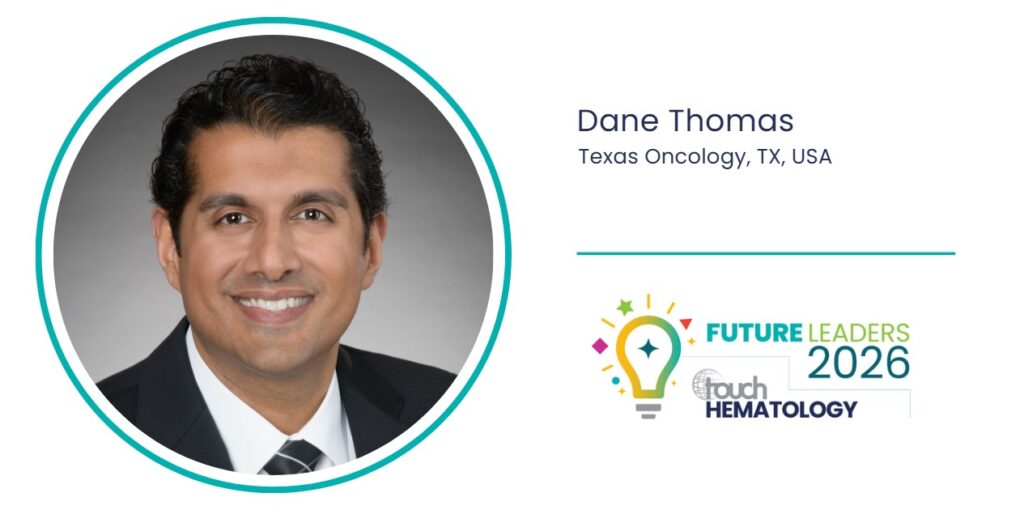
 We are delighted to announce Dane Thomas as a touchHEMATOLOGY Future Leader 2026, selected as a rising star poised to shape the future of hematology care through clinical excellence, education, mentorship, and leadership in advanced practice.
With more than 15 years of experience in hematology and oncology, Dane Thomas has built a career defined by a deep commitment to patient-centered care. A Physician Assistant at Texas Oncology and recipient of the 2024 America’s Top Hematology/Oncology PA award, Dane is recognized nationally for his contributions to patient management, clinical education, and leadership within the oncology workforce.
In this touchHEMATOLOGY Future Leader 2026 interview, Dane Thomas discusses the mentors who shaped his career, the diagnostic curiosity that drives his passion for hematology, and the importance of empathy, education, and shared decision-making in advancing patient care.

“Combining scientific expertise with empathy allows patients to feel informed, supported, and confident in their care”
Can you tell us about a mentor who significantly impacted your career, and the most valuable lesson they shared with you?
Throughout my career, I’ve had the privilege of learning from several outstanding hematologists who challenged me to think critically and approach every patient with curiosity. One lesson that has stayed with me is that laboratory values tell part of the story, but patients tell the rest. Hematology is often like solving a complex puzzle, and I’ve learned that careful listening, thorough clinical evaluation, and thoughtful interpretation of diagnostic data are just as important as understanding the science. That mindset has shaped how I care for patients and how I teach students and fellow advanced practitioners.
What aspects of your work do you find most fulfilling?
The aspect of hematology I find most fulfilling is solving complex diagnostic challenges while building meaningful relationships with patients. Many hematologic disorders require careful evaluation, thoughtful interpretation of laboratory findings, and collaboration across multiple specialties. I enjoy helping patients understand conditions that are often unfamiliar or anxiety-provoking and developing individualized treatment plans that improve both their health and quality of life. I also enjoy educating colleagues and advanced practitioners, helping increase confidence in evaluating and managing hematologic disorders.
Is there a particular moment or experience in your career that reinforced your passion for your specialty?
Early in my hematology career, I realized that some of the most rewarding cases weren’t always the rarest. They were the patients whose diagnosis had been missed or delayed despite months or even years of symptoms. Being able to identify the underlying cause of unexplained anemia, thrombocytopenia, or other hematologic abnormalities and provide patients with answers reinforced my passion for hematology. Those experiences reminded me how impactful thoughtful clinical reasoning can be and continue to inspire my commitment to this specialty.
Looking ahead, what do you anticipate will be the biggest advancements or changes in your field over the next decade?
I believe hematology will continue to evolve rapidly through advances in molecular diagnostics, genomic testing, and precision medicine. Our ability to identify the underlying mechanisms of hematologic disorders will lead to earlier diagnoses and more targeted therapies for both benign and malignant diseases. Artificial intelligence and digital decision-support tools will likely improve diagnostic efficiency and help clinicians recognize complex hematologic patterns more quickly. I also anticipate that advanced practitioners will play an increasingly important role in expanding access to specialized hematology care, leading initiatives to expand access to hematology care, and managing patients with chronic hematologic conditions.
What advice would you offer to those just beginning their journey in your specialty?
Be curious and embrace the complexity of hematology. It’s a specialty that rewards lifelong learning and critical thinking. Don’t be intimidated by abnormal laboratory results. Instead, learn to understand the physiology behind them. Seek out mentors, ask questions, and never hesitate to review a peripheral smear or revisit the fundamentals. Most importantly, remember that every abnormal blood count represents a person, not just a laboratory value. Combining scientific curiosity with compassionate patient care will make you a stronger clinician.
How has working with patients shaped your approach to medicine?
My patients have taught me that medicine is about much more than making the correct diagnosis. Many hematologic disorders are chronic conditions that require long-term follow-up and ongoing communication. I’ve learned the importance of understanding each patient’s goals, concerns, and daily challenges before developing a treatment plan. Taking time to educate patients about their diagnosis empowers them to become active participants in their care and ultimately leads to better outcomes and stronger therapeutic relationships.
How do you balance the technical aspects of your work with the empathetic side of patient care?
Hematology requires a strong foundation in pathophysiology, laboratory interpretation, and evidence-based medicine, but those technical skills are only part of providing excellent care. Patients often come to us with uncertainty and anxiety surrounding abnormal blood work or a possible blood disorder. I strive to explain complex concepts in a way that patients can understand while taking the time to address their concerns and answer their questions. I believe combining scientific expertise with empathy allows patients to feel informed, supported, and confident in their care.
What role do patients play in shaping how you approach treatments and make clinical decisions?
Patients are essential partners in every clinical decision. While evidence-based guidelines provide the framework for diagnosis and treatment, each patient’s values, preferences, lifestyle, and goals help determine the most appropriate plan of care. This is especially important in hematology, where treatment decisions often involve balancing risks and benefits over many years. I believe shared decision-making leads to better outcomes, greater patient satisfaction, and stronger therapeutic relationships because patients feel heard, respected, and actively involved in their care.
Disclosures: This short article was prepared by touchHEMATOLOGY in collaboration with Dane Thomas. No fees or funding were associated with its publication.
Citation: Dane Thomas on curiosity, compassion, and patient-centered hematology: touchHEMATOLOGY Future Leaders 2026. touchHEMATOLOGY. 22 July 2026.
Register now to receive the touchHEMATOLOGY newsletter!
Don’t miss out on hearing about our latest peer reviewed articles, expert opinions, conference news, podcasts and more.