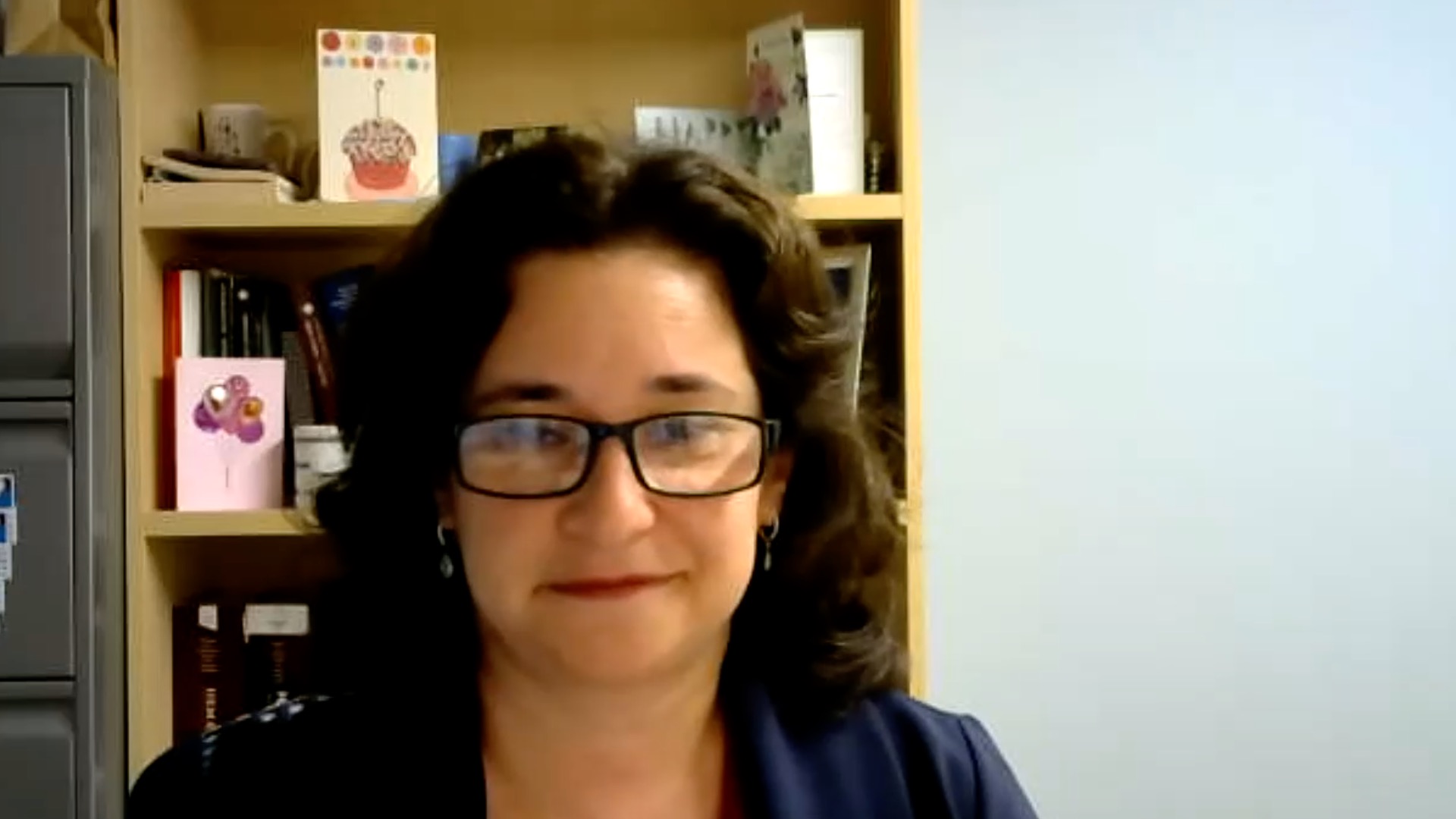
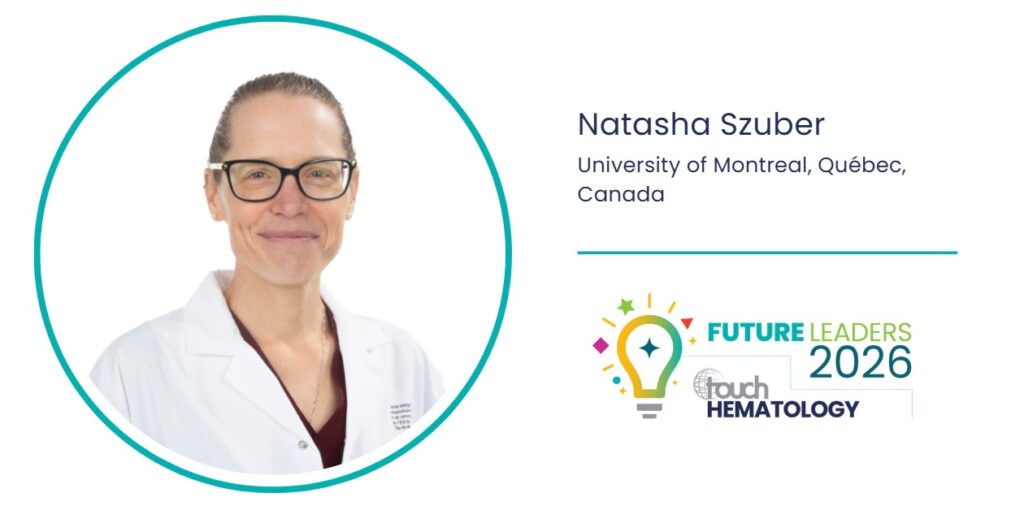
 We are delighted to announce Dr Natasha Szuber as a touchHEMATOLOGY Future Leader 2026, selected by her peers as a rising star poised to shape the future of precision hematology through innovative diagnostics, translational research and collaborative leadership.
As a clinician-scientist at Maisonneuve-Rosemont Hospital in Montreal and an FRQS Scholar, Dr Natasha Szuber has built a career at the intersection of compassionate patient care and innovative research. With a Master’s degree in Physiology from McGill University and clinical expertise in myeloproliferative neoplasms and related disorders, she is helping to advance understanding of these complex diseases while playing leading roles within the Québec CML–MPN Research Group and the Canadian MPN Group.
In this touchHEMATOLOGY Future Leader 2026, Dr Szuber reflects on the mentors who inspired her to challenge established thinking, the privilege of supporting patients through chronic hematologic malignancies and the satisfaction of translating scientific questions into discoveries that improve care. She also discusses the importance of finding a professional niche, embracing curiosity and viewing setbacks not as failures, but as opportunities to develop the resilience and confidence needed for a successful career in hematology.

“Scientific curiosity begins with questioning and re-questioning existing practices and paradigms. The value of asking the right questions is one of the greatest lessons my mentors taught me… Find your niche, discover what you do best and fully lean into it.”
Can you tell us about a mentor who significantly impacted your career, and the most valuable lesson they shared with you?
I have been fortunate to have been guided by two exceptional mentors: Dr Lambert Busque here in Canada at the University of Montreal, and Dr Ayalew Tefferi during my fellowship (now extending beyond) at the Mayo Clinic. Firstly, both have always encouraged me to be scientifically curious – to question and requestion existing practices and paradigms – they really opened my eyes to the value of asking the right questions. Secondly, both have been outstanding role models in navigating the complex balance of clinical practice and leadership in research, exemplifying the perfect marriage between those complementary roles and responsibilities and embodying the very ‘complete’ and well-rounded archetype of the clinician-scientist. Finally, both were adept at striking the balance between mentorship and guidance, while allowing me the space and offering me the tools I needed to grow autonomously and gain confidence over time. They trusted me – and that went a long way in my professional development as a clinician-scientist, as well as my personal growth.
What aspects of your work do you find most fulfilling?
The beauty of a career as a researcher-scientist is that you really get to explore and enjoy the best of both worlds. In clinic, I feel privileged to be a part of my patients’ trajectory. Even when therapeutic options may be limited, I find tremendous meaning in being present for them – to listen, to exchange, to care – and to share in the connection that develops as they navigate life with a chronic hematologic malignancy. Given the sense of vulnerability and uncertainty that many of our patients experience, it is so fulfilling to represent that source of stability and reassurance for them. From a research perspective, two aspects are especially fulfilling. First, I love mentoring and teaching young researchers – integrating them into the team, fostering their growth, and witnessing their discovery of how stimulating and rewarding research can be! Seeing some of these trainees then go on to pursue research at a higher level is also so satisfying. Second, the creative dimension of research is extremely fulfilling to me: identifying novel questions, designing studies to address them, and ultimately circling back to generate concrete answers. This is especially gratifying when the information gained has the potential to directly inform patient care and improve clinical outcomes.
What advice would you offer to those just beginning their journey in your specialty?
I would certainly build on what my mentors have taught me, and in addition, would encourage those just starting out to find a ‘niche’ and really develop expertise within it – to tap into their most unique strengths and capabilities to forge a career path that is truly their own. Discover what you do best (and love) and fully lean into it! I would also remind them to remain curious, to embrace and enjoy their work and to find fulfillment in the process itself, whether it be caring for patients or leading a clinical study. We are fortunate to get to do what we do – and it’s important to remind ourselves of that. Finally, I would emphasize the importance of patience, persistence, and resilience, particularly within the research sphere. I have always learned and grown so much from my failures and setbacks – and while they seem challenging and sometimes painful at the time, these experiences ultimately foster strength and maturity, shaping you into a more capable scholar and a better version of yourself.
Disclosures: This short article was prepared by touchHEMATOLOGY in collaboration with Dr Natasha Szuber. No fees or funding were associated with its publication.
Citation: Dr Natasha Szuber on finding your niche, embracing curiosity, and advancing MPN research: touchHEMATOLOGY Future Leaders 2026. touchHEMATOLOGY. 22 July 2026.
Register now to receive the touchHEMATOLOGY newsletter!
Don’t miss out on hearing about our latest peer reviewed articles, expert opinions, conference news, podcasts and more.