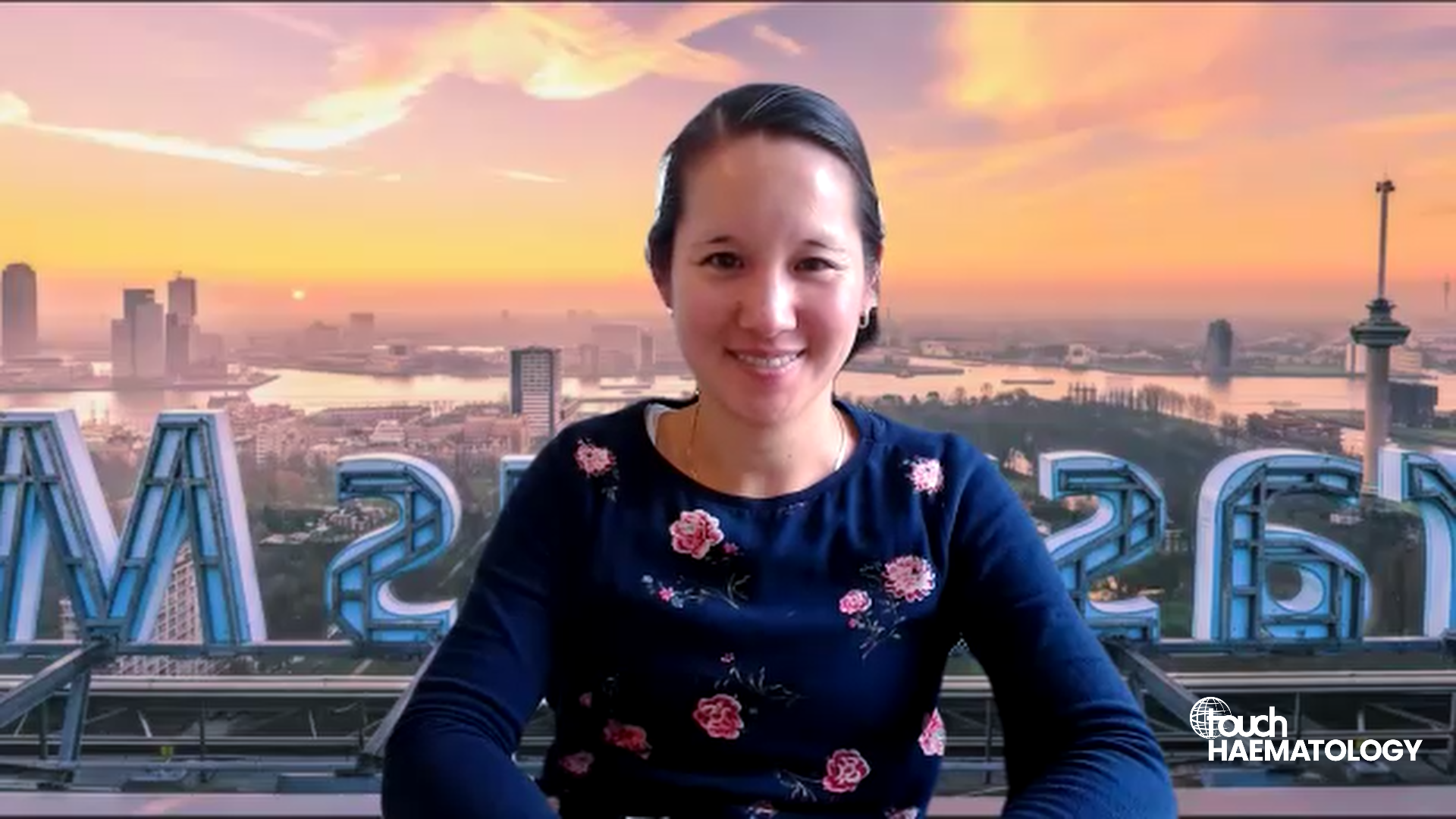
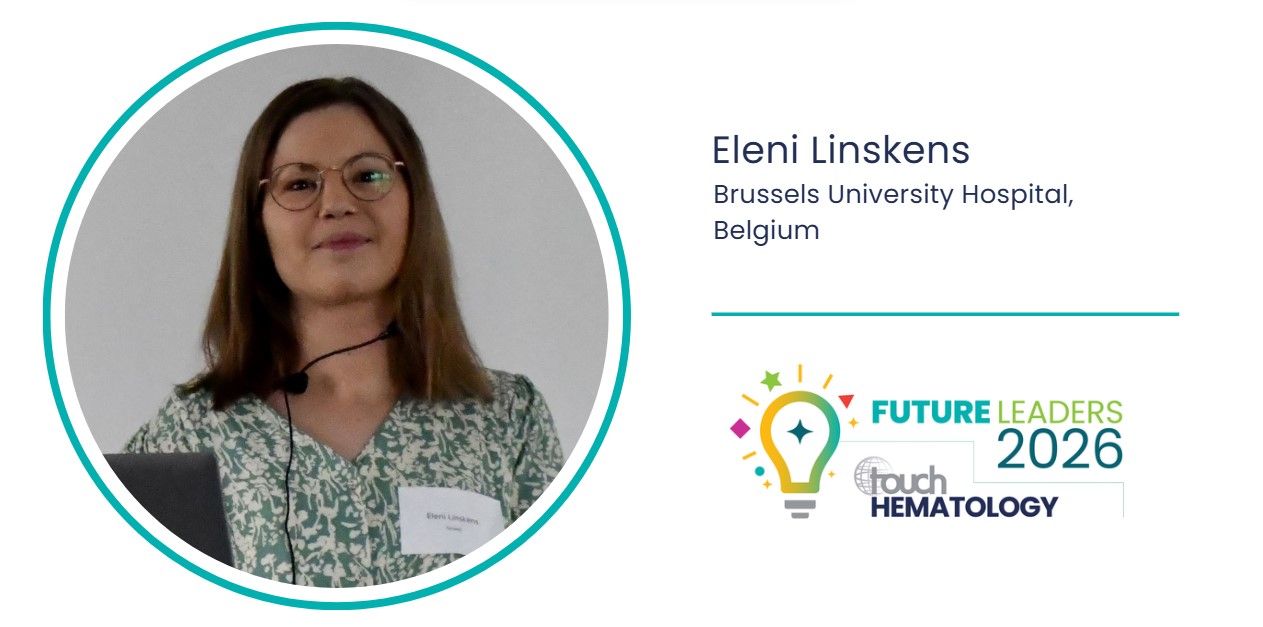
 We are delighted to announce Eleni Linskens as a touchHEMATOLOGY Future Leader 2026, selected by her peers as a rising star poised to shape the future of molecular hemato-oncology and diagnostic innovation.
Eleni Linskens is a Clinical Biologist at the University Hospital of Brussels (UZB), Belgium. After completing a Master’s degree in Pharmaceutical Sciences at Ghent University, she undertook a five-year internship in Clinical Biology at Ghent University Hospital (UZG), where she developed a particular interest in hematology and immunology. Following qualification as a Clinical Biologist, she joined the Department of Clinical Biology – Laboratory of Haematology and Immunology at UZB. She is currently responsible for the molecular haemato-oncology laboratory and the flow cytometry laboratory, which primarily provide analyses for haemato-oncology and primary immunodeficiency diagnosis and follow-up.
As UZB serves as Belgium’s reference laboratory for molecular minimal residual disease (MRD) analysis in patients with acute lymphoblastic leukemia (ALL), Eleni Linskens recently assumed responsibility for this national programme alongside the laboratory’s molecular MRD team.
In this touchHEMATOLOGY Future Leaders interview, Eleni Linskens discusses the mentors who inspired her passion for laboratory hematology, the importance of collaboration in delivering excellent patient care and how AI and molecular diagnostics are set to transform the future of the field.

“I hope I can pass on the same spark, passion and enthusiasm for the hematology laboratory that my mentors gave to me”
Can you tell us about a mentor who significantly impacted your career, and the most valuable lesson they shared with you?
My love for the hematology laboratory was already present before I even started as a trainee in the lab. All different disciplines within the hematology laboratory spoke to me, however my passion for flow cytometry in hemato-oncology and immunodeficiency diagnostics was sparked by two mentors at the UZG hospital, Dr Mattias Hofmans and Prof Carolien Bonroy. During my trainee years, they encouraged my enthusiasm and gave me the opportunity to resolve cases and participate in interesting projects on these topics. This was the fuel I needed to grow into the clinical biologist I am now.
For my passion and curiosity in molecular hemato-oncology and especially my interest in molecular minimal residual disease detection, I have to thank Dr Marleen Bakkus, our molecular biologist at UZB who retired earlier this year. When she talked about molecular MRD, she radiated enthusiasm, and she passionately shared her knowledge and also her questions/remarks, for which the answers still have to be discovered, to everyone who showed interest and enthusiasm. This was one of the reasons I gladly joined her team to work closely with her and learn.
By looking back, I hope I can give the same spark, passion and enthusiasm for the hematology laboratory I received (and still receive) from these three mentors, to the technicians and trainees I am mentoring now.
What aspects of your work do you find most fulfilling?
Unraveling a challenging case, where all laboratory disciplines have to come together, gives me a smile at the end of the day. I’m so happy to be able to work together with wonderful colleagues, where we can openly discuss difficult cases and collaborate to put results of all laboratory disciplines and clinical information together. This is of utmost importance for a fast and correct clinical diagnosis and, in my opinion, essential for excellent patient care.
Looking ahead, what do you anticipate will be the biggest advancements or changes in your field over the next decade?
One of the biggest changes and challenges in the field of laboratory diagnostics will be for sure the use of artificial intelligence (AI). Nowadays it is already used, however, in a very limited way. I think further implementing AI will bring the challenge to maintain the balance between the quality assurance necessary in a clinical laboratory and discovering new potential workflows that will bring diagnostics in a clinical lab to a higher level.
Another topic within my field that will bring big changes is the explosion of new sequencing techniques that are currently on the rise. These advancements in molecular techniques go so fast, it is sometimes hard to follow from a clinical laboratory point of view, which can be different compared to a research setting. However, these improvements in techniques will bring the possibility to achieve higher quality data at lower cost and will, according to me, also shape the changes in the molecular diagnostics field in the near future.
What advice would you offer to those just beginning their journey in your specialty?
Find your passion within the field and always stay curious during your work. I think still learning new things every day is what makes a job as physician, researcher, etc. so exciting. For me this is the recipe for happiness and excellence during my work.
Disclosures: This short article was prepared by touchHEMATOLOGY in collaboration with Eleni Linskens. No fees or funding were associated with its publication.
Citation: Eleni Linskens on advancing molecular diagnostics and laboratory hematology: touchHEMATOLOGY Future Leaders 2026. touchHEMATOLOGY. 22 July 2026.
Register now to receive the touchHEMATOLOGY newsletter!
Don’t miss out on hearing about our latest peer reviewed articles, expert opinions, conference news, podcasts and more.