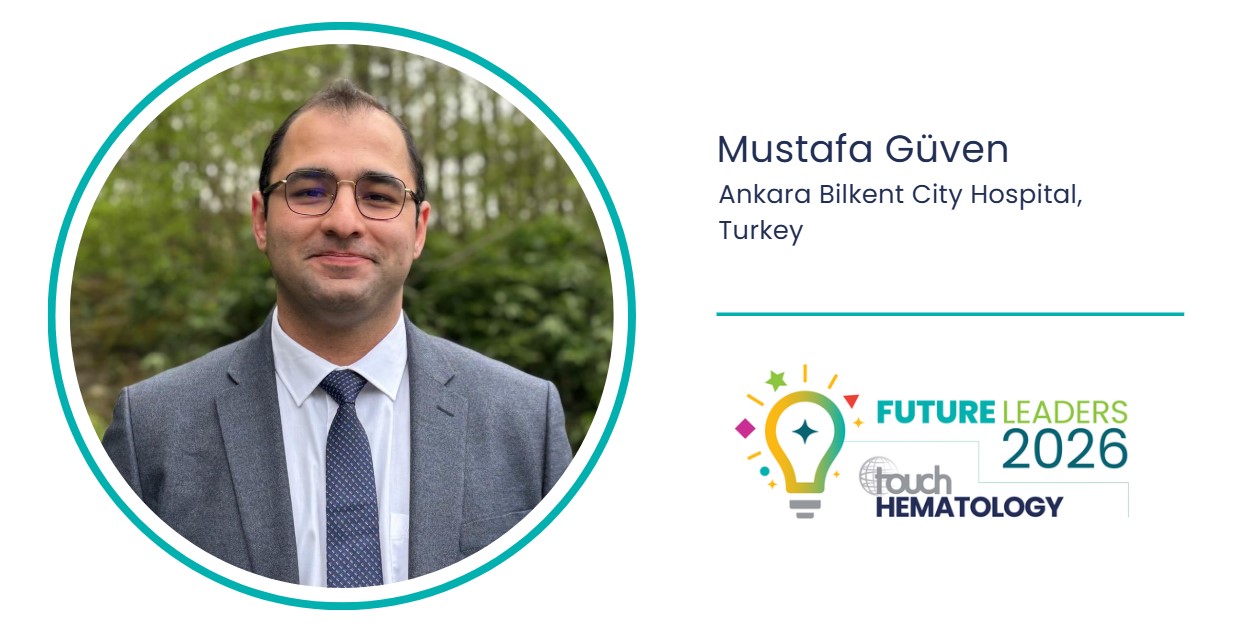
 We are delighted to announce Dr Mustafa Güven as a touchHEMATOLOGY Future Leader 2026, selected by his peers as a rising star poised to shape the future of cellular therapies and translational science.
Dr Mustafa Güven is a Resident Physician in the Department of Internal Medicine at Ankara Bilkent City Hospital, Turkey. His main interests include transplant complications, cellular therapies and translational science, with a focus on clinically relevant questions that can inform practice. He received the Best Young Oral Presentation Award at the 50th Annual Meeting of the EBMT (EBMT24) and has authored an EBMT registry study. Dr Güven is a member of the EBMT Trainee Committee and the EBMT Transplant Complications Working Party.
In this touchHEMATOLOGY Future Leaders interview, Dr Güven reflects on the value of mentorship, translating bedside experiences into meaningful research, and the importance of embracing opportunities early in a medical career.

“Some of the best opportunities in my career began with a simple email or message”
Can you tell us about a mentor who has had a significant impact on your career, and the most valuable lesson they have shared with you?
In every profession mentorship matters, but in medicine it is truly critical. In that sense, I feel fortunate. Throughout my career, I have had mentors who were especially valuable for the specific stage I was in. Not long after starting medical school, I understood the importance of having a mentor, by experiencing what it means to have one. Later, as my career interests evolved in different directions, new mentors helped me navigate those transitions and broaden my perspective. Today, I have the privilege of learning from more than one mentor, which I consider a rare advantage. Collectively, the most valuable lessons my mentors have shared are to keep asking why and to understand the underlying reasons rather than accepting that something is simply ‘the way it is’, to protect the excitement and joy, and to remain humble while continuing to improve.
How has working with patients shaped your approach to medicine?
Working with patients has reshaped my approach from managing diseases to caring for people. Beyond selecting the right therapy, I now begin by understanding what truly matters to the patient; their goals, fears, and day-to-day needs, and I try to integrate symptom relief and quality of life alongside disease-directed care. It has also changed how I interpret evidence and clinical statistics. Early in my training, I wrote in a manuscript introduction that the overall survival in glioblastoma is around 14 months and that new therapeutic approaches are needed. After following a glioblastoma patient on the inpatient service, that statistic became personal. It became a time that a patient and their family measure in uncertainty, priorities, and decisions. This experience has made me more attentive to communication and goal-concordant care, and it has strengthened my scientific focus toward bedside-driven questions that can translate into meaningful impact.
What advice would you offer to those just beginning their journey in your specialty?
I’m still early in my own career, so I prefer to share what has genuinely worked for me. Since medical school, I have often asked myself a simple question: what do I really stand to lose by sending that email, introducing myself to that person, or attending that meeting? Acting on that question led me to take on opportunities that might have seemed beyond my level at the time, and I have not regretted it. It brought new friendships, the chance to see different parts of the world, and real growth in research and professional development. One example is joining the EBMT Trainee Committee, which started with a straightforward message to Dr Nico Gagelmann on Twitter, and then the EBMT community helped me take the next steps. My advice is to think carefully, but do not overthink yourself out of action. Ask “what do I stand to lose?”, take a step forward, and let small initiatives compound over time.
What aspects of your work do you find the most fulfilling?
The most fulfilling part of my work is the combination of constant learning and direct impact. Hematology evolves rapidly, and there is always new evidence that challenges your assumptions or improves how you treat patients. That pace keeps the work intellectually alive. And on a personal note, I truly enjoy the microscope. Looking at a smear, recognizing patterns, and linking morphology to the clinical story is still one of the most satisfying parts of my day.
Disclosures: This short article was prepared by touchHEMATOLOGY in collaboration with Dr Mustafa Güven. No fees or funding were associated with its publication.
Citation: Dr Mustafa Güven on embracing opportunity, scientific curiosity and learning through every patient: touchHEMATOLOGY Future Leaders 2026. touchHEMATOLOGY. 22 July 2026.
Register now to receive the touchHEMATOLOGY newsletter!
Don’t miss out on hearing about our latest peer reviewed articles, expert opinions, conference news, podcasts and more.