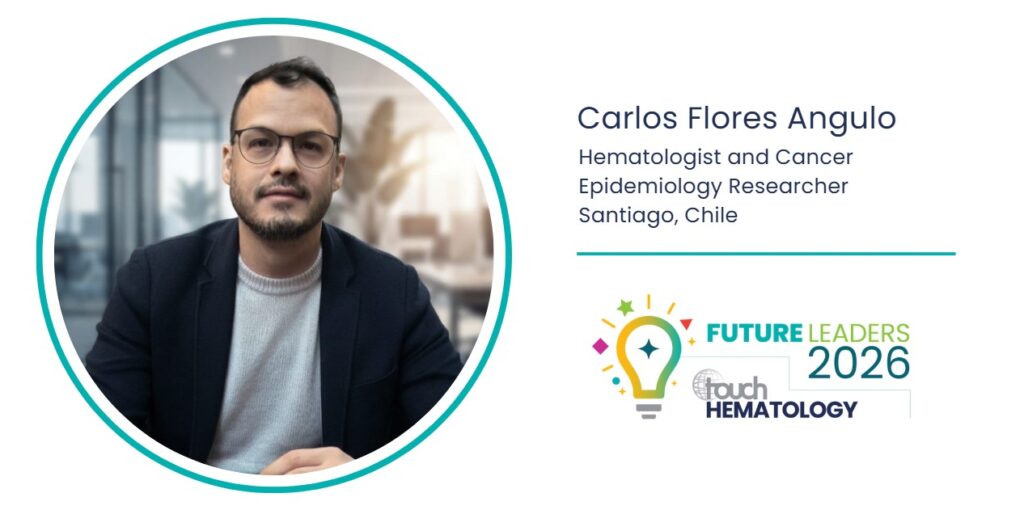
 We are delighted to announce Dr Carlos Flores Angulo as a touchHEMATOLOGY Future Leader 2026, selected by his peers as a rising star poised to shape the future of population-based cancer epidemiology.
Dr Carlos Flores Angulo is a Venezuelan physician and hematologist based in Santiago, Chile. He holds a Master’s degree in Biomedical Sciences, with a focus on Biochemistry and Molecular Biology, and a Master’s degree in Innovation in University Teaching in Health Sciences. He is currently completing his PhD in Epidemiology, where his work focuses on cancer epidemiology, territorial inequalities, rurality, and spatial patterns of cancer mortality.
His career brings together clinical care, biomedical research and population-based cancer epidemiology. As a hematologist, he has cared for patients with complex hematologic cancers; as an epidemiologist, he studies how place, access, and health systems shape cancer outcomes. He developed the Index of Relative Rurality for Chile and has applied spatial and spatiotemporal models to study territorial cancer profiles. His current work seeks to connect clinical oncology with precision public health, using data to identify gaps, guide resources, and strengthen cancer surveillance.
In this touchHEMATOLOGY Future Leaders interview, Dr Flores Angulo reflects on the key lessons that have shaped his career, the importance of understanding patients beyond their diagnosis and how linking clinical hematology with cancer epidemiology can help improve outcomes.

“Every statistic represents a person who experienced symptoms, uncertainty, waiting times and difficult decisions”
Can you tell us about a mentor who significantly impacted your career, and the most valuable lesson they have shared with you?
I have been fortunate to learn from both clinical and academic mentors who shaped the way I understand medicine. One of the most valuable lessons I received was that good medical care requires looking at the patient in more than one dimension. There is the individual patient in front of us, with a diagnosis, fears, expectations, and treatment decisions. But there is also a broader context: where that person lives, how quickly they reached care, what resources were available, and how the health system responded. That lesson has stayed with me and has strongly influenced my path from clinical hematology into cancer epidemiology.
What aspects of your work do you find the most fulfilling?
What I find most fulfilling is working at the intersection between clinical medicine and population health. In hematology, I see how personal and complex cancer care can be. In epidemiology, I can step back and identify patterns that are not always visible in the consultation room: territorial inequalities, differences in access, delayed diagnosis, and gaps in health services. Being able to connect those two levels is very meaningful to me. It allows me to transform clinical questions into population-level research, and research findings into evidence that can support better decisions.
Is there a particular moment or experience in your career that reinforced your passion for your specialty?
Caring for patients with hematologic cancers reinforced my passion for hematology, but it also made me aware of the limits of clinical care when the system around the patient is fragmented. I have seen how much difference timely diagnosis, access to specialized tests, coordinated referral, and treatment availability can make. These experiences taught me that improving cancer outcomes requires excellent clinical care, but also better surveillance, better planning, and a clearer understanding of territorial gaps. That is one of the reasons I became increasingly interested in cancer epidemiology.
Looking ahead, what do you anticipate will be the biggest advancements or changes in your field over the next decade?
In hematology, we will continue to see major advances in molecular diagnosis, targeted therapies, immunotherapy, and cellular therapies. These developments are already changing the way we diagnose and treat many hematologic cancers. However, I believe one of the most important changes will be expanding the idea of precision beyond the individual patient and toward precision public health.
Precision should not be limited to genetic or molecular information. It should also help us understand where risks concentrate, where diagnosis is delayed, where services are scarce, and which communities require more focused interventions. The next decade should bring a stronger connection between biological precision, territorial intelligence, and health-system planning.
What advice would you offer to those just beginning their journey in your specialty?
I would tell them to become technically strong, but never lose sight of the patient’s context. Hematology requires deep knowledge of biology, diagnostics, and treatment, but cancer care is also shaped by access, timing, communication, and trust. I would encourage young physicians to ask questions beyond the clinical chart: Who reaches care late? Which patients face more barriers? What can the system do better? A good specialist should understand the disease, the person, and the health system in which care takes place.
How has working with patients shaped your approach to medicine?
Working with patients has made my approach to medicine more grounded and more responsible. It reminds me that every statistic represents a person who experienced symptoms, uncertainty, waiting times, difficult decisions, and treatment. This has deeply influenced the way I do research. I am not interested in data only as numbers; I am interested in what data can reveal about real problems and how it can help improve access, planning, and care. Patients have taught me that good medicine requires scientific precision, but also a clear sense of responsibility toward people’s lives.
How do you balance the technical aspects of your work with the empathetic side of patient care?
I do not see technical precision and empathy as separate parts of medicine. A careful diagnosis, a well-supported treatment decision, and a rigorous interpretation of evidence are all forms of respect for the patient. But technical expertise needs to be accompanied by listening, clarity, and an understanding of the person’s context. In hematology, many decisions have profound implications for daily life. I try to explain things honestly, acknowledge uncertainty when it exists, and consider the patient’s values, fears, and priorities when making decisions.
What role do patients play in shaping how you approach treatments and make clinical decisions?
Patients play a central role. The best clinical decisions must be scientifically sound, but also realistic and meaningful for the person receiving care. Symptoms, priorities, family support, economic conditions, place of residence, and expectations all influence how a treatment can actually be implemented. In cancer care, deciding is not only choosing a treatment regimen; it also involves thinking about timing, toxicity, continuity of care, and quality of life. That same perspective also shapes my population-level work: evidence should help us make health decisions that are more relevant to people and to the places where they live.
Disclosures: This short article was prepared by touchHEMATOLOGY in collaboration with Dr Carlos Flores Angulo. No fees or funding were associated with its publication.
Citation: Dr Carlos Flores Angulo on bridging precision public health and epidemiology: touchHEMATOLOGY Future Leaders 2026. touchHEMATOLOGY. 22 July 2026.
Register now to receive the touchHEMATOLOGY newsletter!
Don’t miss out on hearing about our latest peer reviewed articles, expert opinions, conference news, podcasts and more.