Phase 3 data presented at EHA 2026 show a 25% reduction in the risk of progression or death with tafasitamab plus lenalidomide and R-CHOP in previously untreated high-risk DLBCL and HGBL, but patient selection is the next key challenge

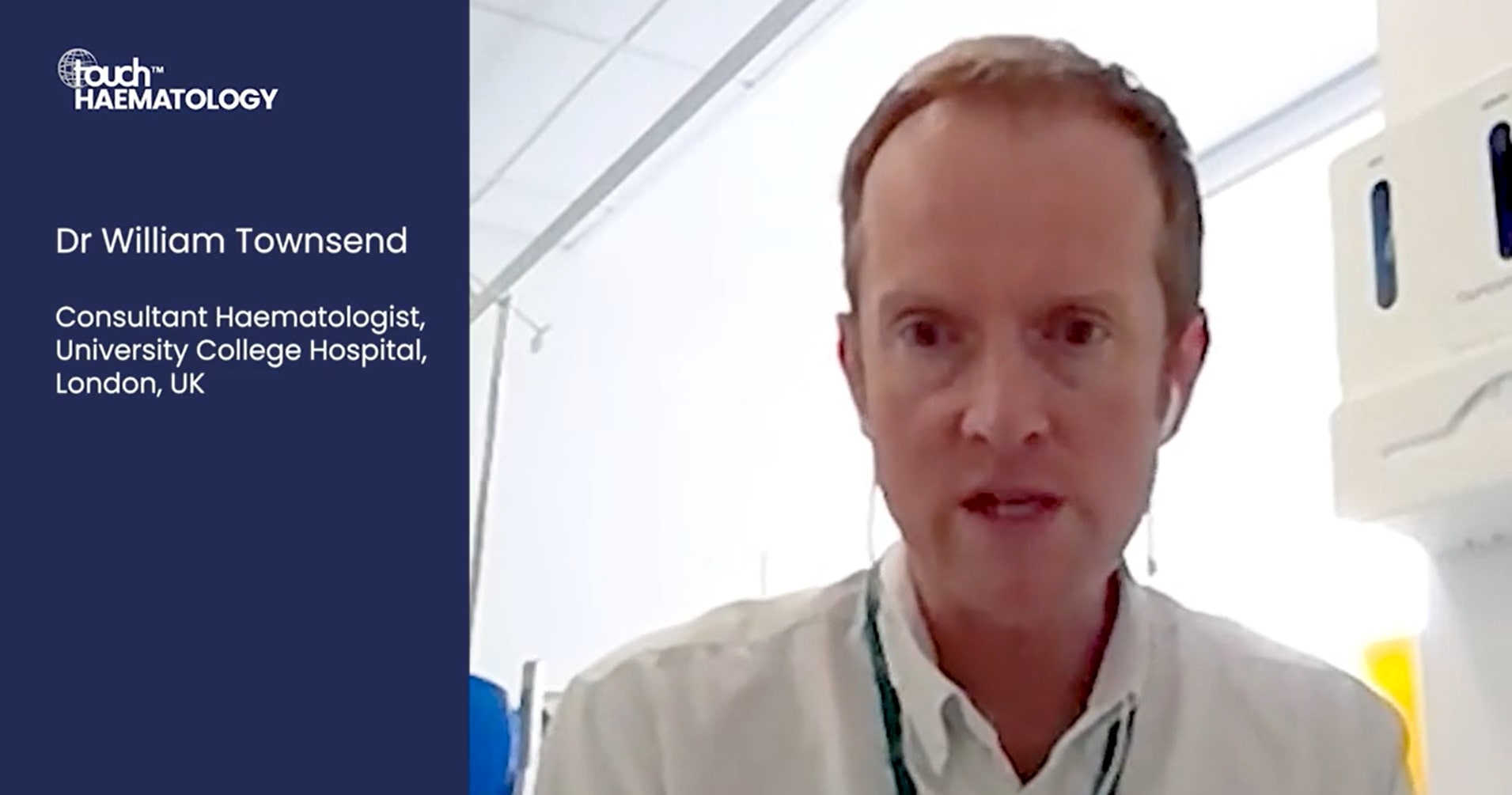
“Tafasitamab plus lenalidomide and R-CHOP is significantly better than R-CHOP for high-risk patients with aggressive lymphoma”
touchHEMATOLOGY coverage from EHA 2026
Abstract EHA-2190: Lenz L, Trněný M, Burke JM, et al. TAFASITAMAB PLUS LENALIDOMIDE AND R-CHOP FOR PATIENTS WITH PREVIOUSLY UNTREATED DIFFUSE LARGE B-CELL LYMPHOMA (DLBCL): RESULTS FROM THE PHASE 3 FRONTMIND STUDY. Presented at: EHA 2026, Stockholm, Sweden. June 11–14th, 2026.
For almost two decades, R-CHOP has remained the established frontline standard for Diffuse large B-cell lymphoma, yet approximately 40% of patients are not cured with first-line therapy. At the European Hematology Association (EHA) 2026 Congress, Prof Georg Lenz (University Hospital in Münster, Germany) presented new phase 3 data from the frontMIND study suggesting that this long-standing backbone may now be open to improvement. The study showed that adding tafasitamab and lenalidomide to R-CHOP significantly improved progression-free survival (PFS) in previously untreated patients with high-risk DLBCL and high-grade B-cell lymphoma (HGBL), marking one of the first positive frontline intensification trials in this setting in recent years.
Speaking after his presentation, Prof Lenz said the biological rationale behind the regimen was central to the study’s success. “We know that tafasitamab and lenalidomide work synergistically,” he said. “The combination is already approved in relapsed or refractory disease, so there was a strong biological rationale. Combining it with R-CHOP appears to be better than R-CHOP alone.”
What did the data show?
The global, double-blind, placebo-controlled frontMIND trial enrolled 899 patients aged 18–80 years with previously untreated high-intermediate or high-risk DLBCL or HGBL. Patients were randomized to receive tafasitamab plus lenalidomide and R-CHOP (n=448) or R-CHOP alone (n=451). At a median follow-up of 35.2 months, the study met its primary endpoint. Tafa-Len-R-CHOP reduced the risk of progression or death by 25% compared with R-CHOP alone (HR 0.75; 95% CI: 0.59–0.96; P=0.019), translating to 24-month PFS rates of 71.1% versus 62.9%. The benefit was even more pronounced in centrally confirmed lymphoma subtypes (HR 0.68; 95% CI: 0.52–0.88), and was seen across both activated B-cell-like and germinal center B-cell-like molecular subtypes, suggesting broad activity regardless of cell-of-origin biology. Event-free survival was also significantly improved, while overall survival remains immature, although trending in favor of the investigational arm. Safety findings were broadly in line with expectations. Grade ≥3 treatment-emergent adverse events were more common with Tafa-Len-R-CHOP (86.7% vs 76.1%), but discontinuation rates remained similar (5.2% vs 5.4%), suggesting the regimen remained feasible in this high-risk population. Prof Lenz emphasized that toxicity management will be critical if the regimen enters clinical practice. “It has the chance to become broadly adopted,” he said. “Obviously, we have to watch for toxicities and handle them well.”
Key clinical takeaway
The emergence of Tafa-Len-R-CHOP adds another option to an increasingly complex frontline treatment landscape, alongside regimens such as polatuzumab-R-CHP. Prof Lenz pointed to the early signal in overall survival as an encouraging aspect of the data. “We are very pleased that the study was positive, particularly for progression-free survival and event-free survival,” he said. “There is also a numerical trend toward an overall survival benefit.”
For Prof Lenz, the next major challenge will be understanding which patients should receive which regimen. “The important question now is which patients benefit most from which treatment,” he said. “We will look at subgroup analyses, molecular analyses, and circulating tumor DNA to help answer that.” Those translational analyses may prove particularly important as clinicians begin to consider sequencing implications, especially in an era where CD19-directed therapies such as CAR-T remain central in relapsed disease.
For now, frontMIND provides one of the clearest signals in years that the longstanding R-CHOP backbone can be improved in biologically aggressive frontline lymphoma. Whether Tafa-Len-R-CHOP ultimately becomes a new standard of care will depend on regulatory approval, reimbursement, and longer-term overall survival follow-up; but the study marks a significant step in refining frontline treatment for high-risk DLBCL.
This content has been developed independently by Touch Medical Media for touchHEMATOLOGY. Views expressed are the speaker’s own and do not necessarily reflect the views of Touch Medical Media. This article was created by the editorial team utilizing AI as an editorial tool (ChatGPT 5.5 [Large language model]. https://chat.openai.com/chat.) The content was developed and edited by human editors. No funding was received in the publication of this article.
Cite: frontMIND marks first major frontline advance over R-CHOP in high-risk DLBCL in decades. touchHEMATOLOGY. 24th June 2026.
Don’t miss out on hearing about our latest peer-reviewed articles, expert opinions, conference news, podcasts, and more.