“Curiosity is key to advance in science, and we are fortunate to work in a field where discoveries can change patients’ lives”
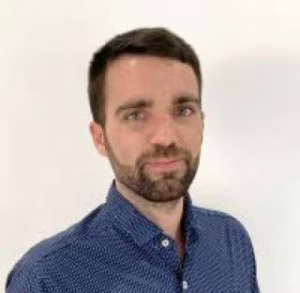
In this interview as part of touchHAEMATOLOGY Future Leaders 2025, we speak with Dr Ferran Nadeu (Post-doctoral Researcher, Hospital Clínic de Barcelona, Spain). A rising star in cancer genomics and haematology, Dr Nadeu reflects on his scientific journey, influential mentors and his vision for the future of translational research in B-cell malignancies.
Q1. Can you tell us about a mentor who has had a significant impact on your career, and the most valuable lesson they have shared with you?
I have had the pleasure to work with many giants in the field of haematology and cancer genomics over the years – some very closely, others through short, but insightful, collaborations. All of them have taught me something and all these inputs have shaped my personality and help me find my personal track in science. So, I am grateful to many great colleagues. But, above all, I would highlight my lasting mentor, Professor Elías Campo, with whom I started when I was studying my bachelor, and I have had the pleasure to work with over the last 13 years. Elías bas been instrumental for my personal and scientific growth, giving me the tools to expand my scientific interests, test new technological developments, enlarge my scientific interests, expand my network of collaborators – some becoming friends after the years – while, at the same time, has provide me the space and visibility to become independent and recognized within my field. I feel honored and privileged for the opportunity to grow in this unique and fruitful environment.
The most valuable lesson? Many over the years. But to pick one, I would select his vision. I have learnt that curiosity is key to advance in science, and that we are fortunate to work in a field where we can make discoveries – discoveries that can change patients’ lives. And, that science is a teamwork and, as such, sharing and collaborating with colleagues is key for success.
Q2. What aspects of your work do you find the most fulfilling?
There are many aspects of the life of a scientist that are really fulfilling. But to make it short, I would pick the attractive nature of trying to discover things and the possibility of mentoring young students and see how they grow personally and scientifically.
Q3. Is there a particular moment or experience in your career that reinforced your passion for your specialty?
It is hard to select only once so I will summarize three. First, when we published my first, first-author paper showing the impact of subclonal mutations in TP53 in the outcome of patients with chronic lymphocytic leukemia. This study made me realize that indeed our findings could have an impact on patients’ lives. Second, and more recent, when we licensed IgCaller – an algorithm to reconstruct the immunoglobulin gene in B-cell neoplasms from sequencing data – for its commercial use world-wide. As a bioinformatician, having a tool used world-wide for the study of B-cell neoplasms, both in the research setting but also commercially, reinforced my interests and believe in translational genomics as well as open and collaborative science. And finally, I feel excited for the era of new technological and therapeutic advances we have nowadays for cancer genomics, which keep me motivated to explore new, uncharted aspects of B-cell leukemias and lymphomas.
Q4. Looking ahead, what do you anticipate will be the biggest advancements or changes in your field over the next decade?
I am very fascinated by the explosion of opportunities that new single-cell and high-resolution sequencing technologies provide us to understand cancer from an evolutionary perspective, from the very recent cell of origin, until tumour diagnosis, going through, in some cases, decades of evolution. I would anticipate – and indeed, we are starting to see – how these technological advances are revolutionizing early cancer detection, the study of genomic alterations in apparently normal cells and tissues, tools for monitoring diseases and changing end-points in the design of clinical trials.
Disclosure: Dr Ferran Nadeu has no financial or non-financial conflicts of interest in relation to this article.
Cite: A Conversation with Dr Ferran Nadeu: touchHAEMATOLOGY Future Leaders 2025. August xxth, 2025
SIGN UP to touchHAEMATOLOGY!
Join our global community today for access to thousands of peer-reviewed articles, expert insights, and learn-on-the-go education across 150+ specialties, plus concise email updates and newsletters so you never miss out.